
As automotive development cycles continue to compress, OEMs are under increasing pressure to make confident design decisions earlier in the program. Virtual engineering and Computed-Aided Engineering (CAE) have become critical tools—but their effectiveness depends entirely on the quality and relevance of the material data behind them.
At Ascend Performance Materials, we are advancing material characterization to help OEMs shorten development timelines, reduce physical testing, and improve correlation between simulation and real-world performance.
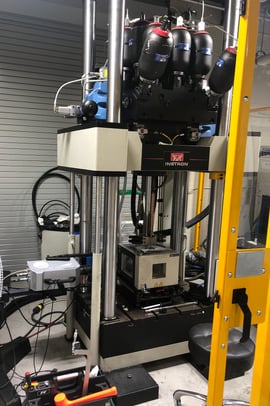
Conventional material datasheets are typically based on quasi-static testing under limited conditions. While useful for basic screening, they often fail to capture how materials behave in real automotive applications.
In automotive service, materials are exposed to:
High strain-rate loading
Directional, fiber-driven anisotropy
Temperature- and moisture-dependent behavior
Complex, multi-axial stress states
When simulation inputs don’t reflect these realities, OEMs are forced to compensate with conservative designs, additional prototype loops, and costly validation testing.
Ascend’s material characterization approach is intentionally designed to align with OEM CAE modeling requirements, not just standard compliance testing.
Using molded flat panels to ensure representative fiber orientation, materials are evaluated across a wide range of application-relevant conditions:
Quasi-static to high strain-rate tensile behavior
Multiple orientations relative to flow direction
High-speed flexural response
Shear, fatigue, and multi-axial impact performance
Testing across relevant temperature conditions
Advanced measurement techniques, including digital image correlation (DIC) as seen in the video below, enable full-field strain analysis and detailed insight into anisotropic behavior—critical inputs for high-fidelity Finite Element Analysis (FEA).
(video for reference purposes only)
At Ascend, the investments we've made in capturing DIC data helps improve CAE modeling by providing detailed, full-field measurements of how materials actually deform under load. DIC captures strain across the entire surface of a test specimen, revealing directional and localized behavior. These richer datasets allow engineers to calibrate and validate simulation models more accurately, leading to CAE predictions that better match real-world material performance.
CAE-ready material data reduces development risk
• High-speed, anisotropic characterization improves correlation between FEA and physical performance.
Fewer physical tests, lower program cost
• Accurate simulation inputs reduce the need for repeated prototype builds and late-stage testing.
Faster decisions earlier in the program
• Reliable material models enable earlier design confidence and shorter development cycles.
Improved NVH and structural optimization
• Engineers can balance stiffness, energy absorption, and durability without overdesign.
Want to know more about how we can help with your application development? Connect with us here.